SEO Best Practices 2026: What Actually Works (And What You Can Stop Doing)
Short answer: SEO best practices in 2026 are no longer about doing more things. They’re about doing fewer things correctly, in the right order.
If you’re confused about SEO in 2026, you’re not alone. Many sites are technically sound, content-rich, and “optimized,” yet growth feels slower or inconsistent. At the same time, some sites with far less effort continue to gain visibility.
That gap isn’t random.
It’s the result of how modern search systems evaluate trust, intent, and usefulness.
Why SEO Feels Different (and Harder) in 2026
In practice, this is what I see repeatedly:
- Sites follow all traditional SEO checklists
- Content is well-written and keyword-aligned
- Technical issues are minimal
- But rankings move slowly or fluctuate
This leads people to assume SEO is broken.
What’s actually happening is simpler:
Search engines now evaluate patterns, not isolated optimizations.
SEO best practices in 2026 reward consistency and alignment, not isolated wins.
The Core Shift Behind SEO Best Practices 2026
Search engines no longer ask:
“Is this page optimized?”
They ask:
“Is this site consistently helpful for this type of problem?”
That single shift explains most changes in SEO behavior.
It also explains why tactics that once worked reliably now feel weaker.
A Simple Mental Model (Very Important)
Use this framework before applying any SEO advice:
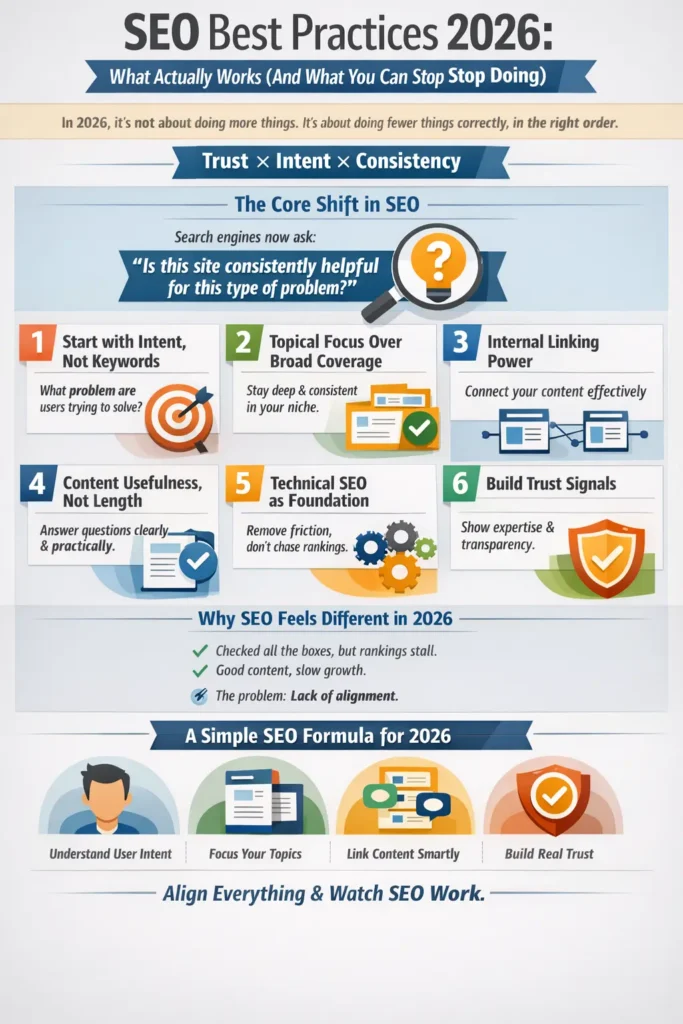
SEO in 2026 = Trust × Intent × Consistency
Not:
- Keywords × backlinks
- Tools × audits
- Content × volume
If one of these breaks, results stall even if everything else looks “right”.
Step-by-Step SEO Best Practices 2026 (What Actually Matters)
1. Start With Intent, Not Keywords
Keywords still matter but intent decides outcomes.
In practice:
- Many pages rank but don’t convert
- Others never rank because intent is misaligned
Ask before creating or auditing a page:
- What problem is the user trying to solve right now?
- Does this page clearly solve that problem?
Pages that “almost” match intent are filtered quickly.
This is covered in depth in SEO Strategy in 2026.
2. Topical Focus Beats Broad Coverage
One of the strongest SEO best practices in 2026 is topical depth.
Search engines trust sites that:
- Cover a topic from multiple angles
- Stay consistent over time
- Reinforce expertise across related pages
Sites that jump between unrelated topics grow slower even if content quality is high.
This is also why your 2026 cluster strategy works well.
3. Internal Linking Is a Ranking Multiplier
Internal linking isn’t just navigation, it’s context.
In practice, strong internal linking:
- Speeds up content evaluation
- Clarifies topical relationships
- Distributes trust naturally
Weak internal linking causes:
- Slow indexing
- Orphaned pages
- Diluted authority
This connects directly with SEO Audit Checklist 2026 and Technical SEO in 2026.
4. Content Quality Is About Usefulness, Not Length
In 2026, long content doesn’t rank because it’s long.
It ranks because it answers questions clearly.
High-performing content usually:
- Explains why, not just what
- Covers edge cases
- Reflects experience
- Sets realistic expectations
Generic explanations are filtered faster than ever by both search engines and AI systems.
This is especially important in an AI-assisted search environment, as discussed in How AI Is Changing SEO in 2026.
5. Technical SEO Removes Friction, It Doesn’t Create Growth
This is one of the most misunderstood SEO best practices in 2026.
Technical SEO:
- Prevents problems
- Improves accessibility
- Supports scalability
It rarely creates growth by itself.
In practice:
- “Perfect” sites don’t automatically rank
- Technically weak sites can still perform if intent and trust are strong
Treat technical SEO as a foundation, not a lever.
6. Trust Signals Matter More Than Ever
Trust is evaluated site-wide, not page-by-page.
This includes:
- Clear author presence
- Editorial transparency
- Consistent tone and expertise
- Real-world examples
Lack of trust doesn’t always cause penalties, it causes slow or capped growth.
You can see this clearly in your own documentation in New Website SEO Case Study – Day 11.
What Most Articles Don’t Explain About SEO Best Practices
Here’s the part rarely said clearly:
SEO best practices in 2026 are less about optimization and more about alignment.
Alignment between:
- Content and intent
- Site and topic
- Promise and delivery
When alignment is weak, SEO feels unpredictable.
When alignment is strong, growth looks “effortless.”
Real-World SEO Scenarios I See Often
Scenario 1: “We did everything right, but nothing changed”
- Over-optimized content
- Weak topical focus
- Too many competing pages
Result:
- Rankings stall
Scenario 2: “One section of the site grows, others don’t”
- Clear topical cluster
- Strong internal links
Result:
- Authority concentrates where focus exists
Scenario 3: “Traffic dropped, but impressions increased”
- AI summaries reduce clicks
- Visibility still improves
Result:
- SEO value shifts upstream
This is discussed in LLM SEO Strategies 2026.
Common SEO Mistakes in 2026
- Publishing without a topical plan
- Chasing keywords instead of intent
- Over-auditing without prioritization
- Expecting quick results from new content
- Treating SEO as isolated tasks
Most SEO problems are structural, not tactical.
A Practical SEO Best Practices Checklist (2026)
Before worrying about rankings, ask:
- Does this page clearly solve one problem?
- Is it part of a larger topical cluster?
- Can search engines understand it easily?
- Does it reinforce site-level expertise?
- Would this still be useful without traffic?
If the answer is “no” to any, fix that first.
FAQs
Is SEO still worth investing in 2026?
Yes, but only if done strategically.
Do keywords still matter?
Yes, but intent and context matter more.
How long does SEO take in 2026?
Typically longer than before, but results are more durable.
Can small sites compete?
Yes, focus and clarity beat size.
Does AI replace SEO?
No. It filters low-value SEO faster.
Should I publish more content?
Only if it strengthens topical authority.
The Counter-Intuitive Truth About SEO Best Practices 2026
The more you chase tactics, the weaker SEO becomes.
The more you focus on:
- Clear intent
- Consistent topics
- Honest explanations
The stronger SEO becomes quietly.
Final Take on SEO Best Practices 2026
SEO best practices in 2026 are not about gaming algorithms.
They’re about:
- Building trust over time
- Solving real problems clearly
- Structuring content intelligently
- Letting systems evaluate patterns
If SEO feels harder now, it’s because standards went up, not because SEO stopped working.
Get the fundamentals right and SEO still compounds.