
YouTube SEO Best Practices 2026: How Videos Actually Get Discovered Now
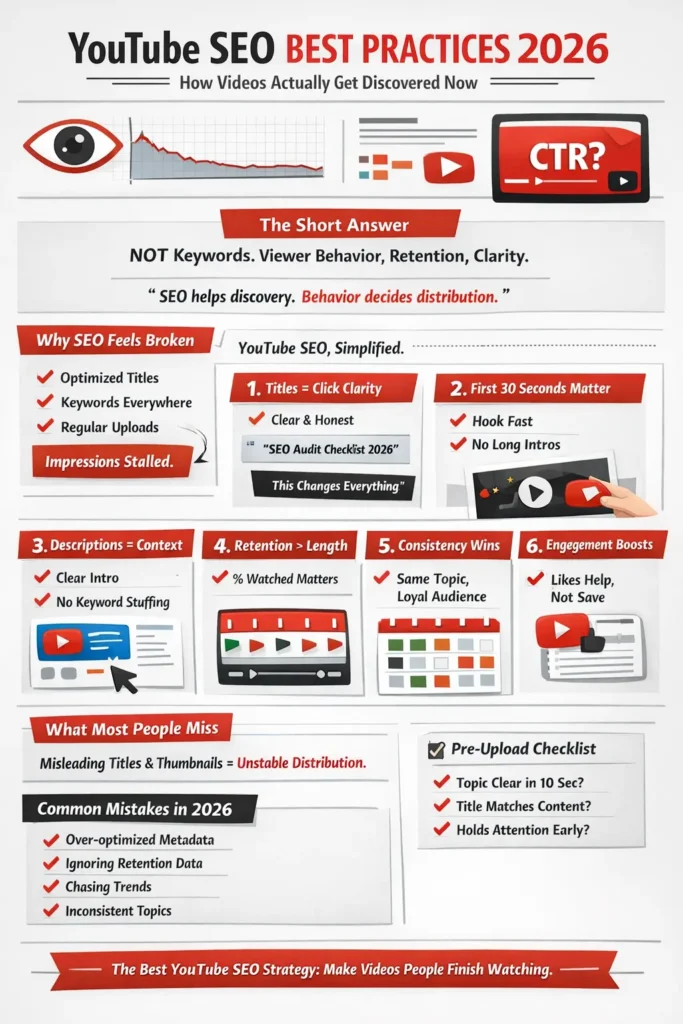
Short answer: YouTube SEO best practices in 2026 are no longer about stuffing keywords into titles or descriptions. They’re about viewer behavior, retention patterns, and content clarity.
If YouTube SEO feels confusing right now, that’s understandable. Many creators follow all the traditional advice like optimized titles, tags, thumbnails and yet their videos still don’t get consistent impressions. Others seem to do very little SEO and still grow.
That’s because YouTube SEO works more like a recommendation system, not a traditional search engine.
Why YouTube SEO Feels Harder in 2026
In practice, this is the pattern I see repeatedly:
- Videos are well-optimized on paper
- Keywords are present everywhere
- Uploads are consistent
- But impressions stall or fluctuate
This leads people to think YouTube SEO is broken or “too competitive.”
What’s actually happening is simpler:
YouTube evaluates performance signals first and metadata second.
SEO helps discovery.
Behavior decides distribution.
How YouTube Search and Discovery Actually Work
YouTube doesn’t ask:
“Is this video optimized?”
It asks:
“Will viewers watch this video and stay on the platform longer?”
To answer that, YouTube tracks:
- Click-through rate (CTR)
- Watch time
- Audience retention
- Session duration
- Engagement signals
- Viewer satisfaction
Titles and descriptions help YouTube understand what the video is about.
Viewer behavior tells YouTube whether to show it more.
This mirrors how modern SEO systems behave, which we’ve covered in SEO Ranking Factors 2026 and SEO Strategy in 2026.
A Simple Mental Model for YouTube SEO (Very Important)
Use this framework:
YouTube SEO = Discovery × Retention × Satisfaction
Not:
- Keywords × tags
- Upload frequency × luck
- Tools × trends
If any one of these breaks, growth slows even if everything else looks “optimized”.
Step-by-Step YouTube SEO Best Practices 2026
1. Titles: Optimize for Click Clarity, Not Clickbait
In 2026, titles that perform well usually:
- Clearly state what the video delivers
- Match exactly what happens in the video
- Avoid vague curiosity
Works better:
- “Why SEO Feels Slower in 2026 (What’s Actually Happening)”
- “SEO Audit Checklist 2026: What Matters, What Doesn’t”
Performs poorly long-term:
- “You Won’t Believe This SEO Trick”
- “This Changes Everything”
High CTR with poor retention hurts distribution.
This aligns closely with what we’ve explained in SEO Meta Description and Title Best Practices 2026.
2. First 30 Seconds Matter More Than Tags
One of the biggest shifts in YouTube SEO best practices in 2026 is front-loaded evaluation.
In practice:
- YouTube heavily evaluates the first 30–60 seconds
- Viewer drop-off here suppresses impressions
- Long intros kill momentum
Videos that perform well:
- State the problem immediately
- Set clear expectations
- Avoid long branding intros
If viewers leave early, YouTube assumes the video didn’t satisfy intent.
3. Descriptions Help Context, Not Rankings
Descriptions are still important but not how most people use them.
In practice, good descriptions:
- Explain the video clearly in the first 2–3 lines
- Reinforce the core topic
- Help YouTube classify content
What doesn’t work anymore:
- Keyword dumping
- Copy-pasted templates
- Long blocks of tags
Descriptions support discovery.
They don’t override behavior.
4. Watch Time Is Evaluated Relative to Video Length
A common misunderstanding:
“Longer videos rank better.”
That’s not true in 2026.
YouTube looks at:
- Percentage watched
- Viewer consistency
- Drop-off patterns
A 6-minute video watched for 4 minutes often outperforms a 20-minute video watched for 6.
Retention quality matters more than duration.
5. Consistency Beats Virality
In practice, YouTube favors channels that:
- Publish within a clear topic
- Attract a predictable audience
- Maintain steady engagement
Random viral videos don’t build channels.
6. Engagement Is a Reinforcement Signal, Not a Trigger
Likes, comments, and shares help but they don’t create growth alone.
In practice:
- Engagement amplifies already-performing videos
- It doesn’t rescue weak ones
- Forced engagement (“comment below”) rarely helps
YouTube prioritizes viewer satisfaction, not interaction tricks.
What Most Articles Don’t Explain About YouTube SEO
Here’s the uncomfortable truth:
YouTube SEO doesn’t reward optimization, it rewards alignment.
If your:
- Title promises one thing
- Video delivers something else
- Thumbnail suggests something different
Distribution becomes unstable.
YouTube suppresses videos that confuse viewers, even if they’re well-made.
This mirrors how Airbnb and Google behave, as explained in Airbnb SEO Optimization Techniques 2026.
Real-World YouTube SEO Scenarios
Scenario 1: “High CTR, low impressions”
- Clickbait title
- Weak retention
Result:
- YouTube tests the video, then stops pushing it
Scenario 2: “Low CTR, strong retention”
- Clear but boring title
- Strong content
Result:
- Gradual growth as YouTube finds the right audience
Scenario 3: “Sudden drop in impressions”
- Topic shift
- New audience mismatch
Result:
- Algorithm resets distribution
Common YouTube SEO Mistakes in 2026
- Over-optimizing metadata
- Ignoring retention data
- Chasing trends outside channel focus
- Publishing inconsistent topics
- Expecting immediate results
Most growth issues come from audience mismatch, not SEO mistakes.
A Practical YouTube SEO Checklist (2026)
Before uploading, ask:
- Is the video topic clear in 10 seconds?
- Does the title match the content exactly?
- Will the right audience click this?
- Does the video hold attention early?
- Would I watch this fully myself?
If the answer is “no” to any fix that first.
FAQs
Do keywords still matter on YouTube?
Yes, for context, not distribution.
Are tags still useful?
Minimally. They help classification, not ranking.
How long does YouTube SEO take to work?
Usually 2-4 weeks for stable signals.
Can new channels grow in 2026?
Yes, if retention and clarity are strong.
Does upload frequency matter?
Consistency matters more than frequency.
Should I delete underperforming videos?
Usually no. Let data accumulate.
The Counter-Intuitive Truth About YouTube SEO in 2026
The best YouTube SEO strategy is not optimization.
It’s making videos people actually finish watching.
Everything else follows from that.
Final Take on YouTube SEO Best Practices 2026
YouTube SEO best practices in 2026 are not about beating an algorithm.
They’re about:
- Clear topics
- Honest titles
- Strong retention
- Consistent audience signals
If your videos aren’t being discovered, the issue is rarely tags or keywords.
It’s almost always viewer alignment.
Fix that and YouTube SEO works quietly in the background.