
New Website SEO Case Study (Day 3): What’s Normal, What’s Not, and What I’m Watching
This case study documents the early SEO behavior of a brand-new website, not a success story.
The website being observed is systemsbeyond.com, which went live on 30 December 2025. The purpose of this case study is to capture what actually happens in search during the first few days of a new site without forcing changes, shortcuts, or premature optimizations.
If you’ve recently launched a website and feel confused by early Search Console data, this case study is meant to reflect that exact phase.
Case Study Context (Day 3 Snapshot)
Website: systemsbeyond.com
Launch date: 30 December 2025
CMS: WordPress
Website type: SEO education and documentation
Total pages live: 9 static pages
Total blog posts live: 2
Indexing status (Day 3)
- Static pages: Indexed
- Blog posts: Not indexed yet
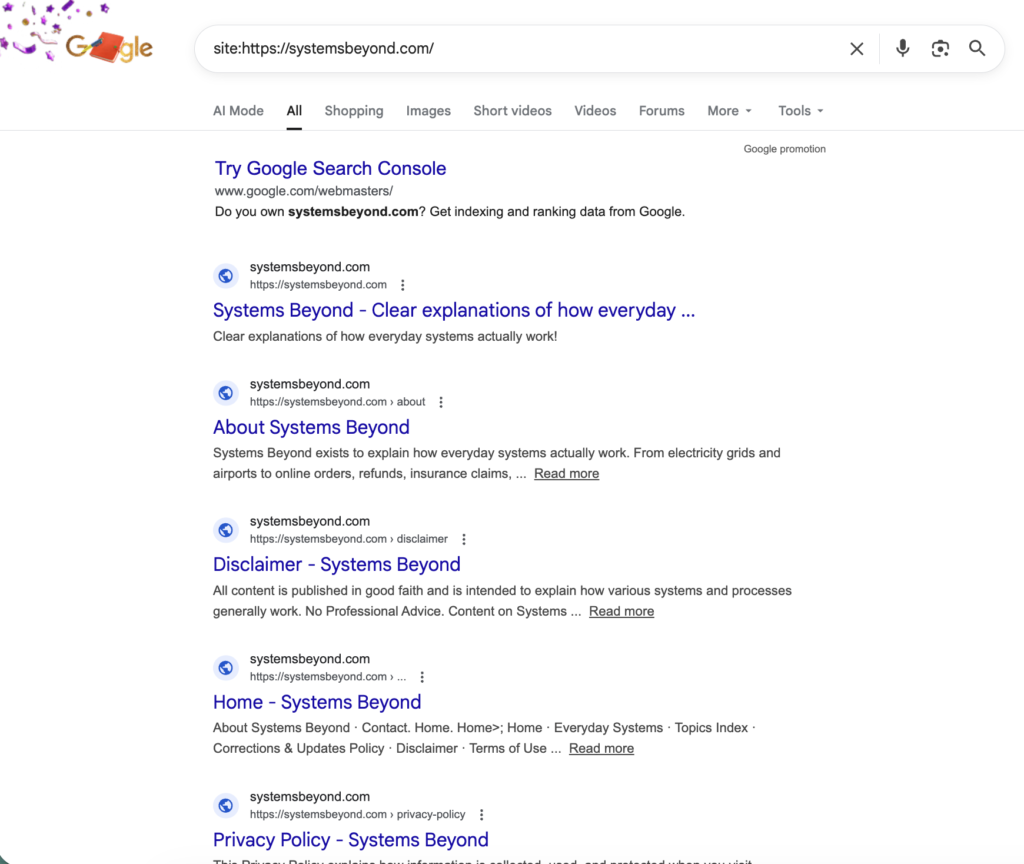
Google Search Console Status on Day 3
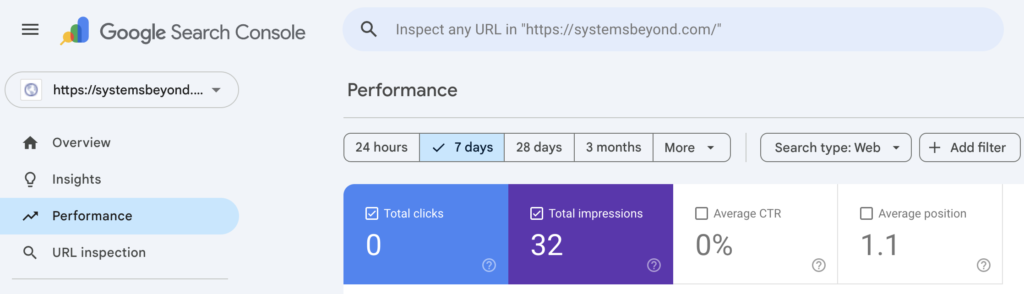
Google Search Console is set up and verified.
Current visibility signals look like this:
- Performance data: Available
- Total impressions: 32
- Clicks: 0
- Queries shown: None
- Coverage report: Not populated yet
- Errors or warnings: None
At this stage, the presence of impressions without visible queries is not unusual.
What I Expected vs What Actually Happened
What I expected
At Day 3, expectations were limited. The focus was on:
- Whether pages were discovered
- Whether core pages indexed
- Whether Search Console started showing any activity
What actually happened
- All main static pages indexed
- Blog posts still pending indexing
- Search Console showing 32 impressions
- No query-level data visible yet
So far, this aligns closely with what I expected for a new website at this stage.
Why Pages Are Indexed but Blog Posts Are Not
This difference is common with new websites.
Static pages tend to index faster because:
- They are linked directly from navigation
- They represent core site structure
- They help define the website’s purpose
Blog posts usually take longer because:
- They have fewer internal links early on
- They need more context to be evaluated
- They are assessed for quality and intent later
At Day 3, this behavior is normal and not a cause for concern.
What I Have Intentionally NOT Done So Far
To keep this case study accurate, I have deliberately avoided:
- No backlink building
- No social media promotion
- No paid traffic
- No aggressive technical changes
- No forced indexing tactics
This is intentional.
Early interference often makes it impossible to understand baseline behavior. Right now, the goal is observation, not acceleration.
What’s Normal at Day 3 for a New Website
Based on real-world patterns seen repeatedly with new sites, the following is normal at this stage:
- Partial indexing
- Incomplete Search Console data
- Impressions appearing before queries
- No rankings or clicks
This phase is about discovery, not performance.
What’s Not Normal (But Often Expected)
At Day 3, it is not realistic to expect:
- Stable keyword rankings
- Consistent query data
- Blog posts ranking immediately
- Clear performance trends
If any of those appear this early, they are usually temporary and not reliable.
What Most Articles Don’t Explain About Early SEO Data
Early Search Console data is observational, not evaluative.
At this stage, Google is:
- Discovering URLs
- Understanding site structure
- Testing where pages might surface
- Collecting early interaction signals
It is not making long-term judgments yet.
A Simple Mental Model for the First Week
Phase 1: Discovery
Pages are found and crawled.
Phase 2: Classification
Content is understood in context.
Phase 3: Evaluation
Visibility stabilizes.
Day 3 sits firmly in Phase 1.
Trying to optimize for later phases too early often creates confusion.
Why 32 Impressions Matter (Even Without Queries)
The number itself is not important for traffic.
What matters is what it signals:
- The website is being surfaced somewhere
- Pages are entering early visibility tests
- Google is beginning evaluation cycles
The absence of queries does not negate this signal.
What I’m Watching Next (Without Changing Anything Yet)
Over the next few days, I’ll be monitoring:
- Blog post indexing
- Appearance of query-level data
- Crawl frequency changes
- Impression consistency
What I’m deliberately not doing yet:
- Rewriting content
- Changing titles
- Adding backlinks
- Forcing updates
Right now, patience provides more clarity than action.
Common Mistakes People Make at This Stage
At Day 3, many site owners:
- Rewrite content too early
- Submit URLs repeatedly
- Obsess over impression counts
- Compare against older sites
- Assume SEO is “not working”
None of these actions help at this phase.
Who This Case Study Is For
This case study is useful if:
- Your website is under 30 days old
- Pages are indexing unevenly
- Search Console feels confusing
- You’re unsure whether to act or wait
It is not meant to show results.
It is meant to show reality.
Key Takeaway at Day 3
At Day 3:
- Silence is normal
- Incomplete data is expected
- Waiting is part of the process
Nothing about the current state of systemsbeyond.com suggests a problem.
The website is behaving exactly as a new site typically does.
What Comes Next
The next case study update will focus on:
- Blog post indexing changes
- Query data visibility
- What shifts (or doesn’t) by Day 10
No forced actions.
No premature fixes.
Just observation.